
Building decision workflows in fintech: UI, governance, and execution boundaries


Building decision workflows in fintech: UI, governance, and execution boundaries
In fintech and regulated environments, workflows are rarely about convenience.
They are about control, auditability, and correctness.
Decision trees, approval flows, and rule-based processes sit at the heart of many fintech platforms - and their UX matters more than most teams expect.
Why decision workflows matter in regulated products
Fintech workflows often involve:
- risk assessment,
- compliance checks,
- approvals and escalations.
Hard-coding these processes leads to:
- slow iteration,
- high deployment risk,
- limited transparency.
Visual workflows help teams separate decision logic from code while keeping execution fully controlled.
Governance starts in the UI
A recurring theme from enterprise calls:
“We need users to design workflows - but not break production.”
This leads to patterns such as:
- draft vs production workflows,
- role-based permissions,
- validation and locking.
A workflow builder becomes not just a design tool, but a governance layer.
Clear execution boundaries in fintech architectures
In regulated environments, execution cannot be outsourced lightly.
That’s why many fintech teams prefer:
- frontend-only workflow builders,
- internal execution engines,
- full ownership of data and logic.
This approach supports:
- auditability,
- compliance requirements,
- internal security policies.
Customization over standardization
Unlike generic automation tools, fintech workflows are:
- domain-specific,
- tightly coupled to business rules,
- subject to frequent regulatory change.
A customizable workflow editor allows teams to adapt UI and behavior without re-architecting execution.
Final takeaway
For fintech and enterprise platforms:
- workflows are critical infrastructure,
- UI is part of governance,
- execution must remain internal.
A frontend-only, extensible workflow builder provides flexibility without sacrificing control.
An entrepreneur and tech enthusiast, with over 14 years of experience building innovative diagramming solutions and tools across industries. Our interfaces help technical and non-technical users make informed business decisions.


Go further with Overflow and Workflow Builder
Workflow Builder is powered by Overflow — a library of interaction components made with React Flow that elevates and extends node-based interfaces.
Articles you might be interested in
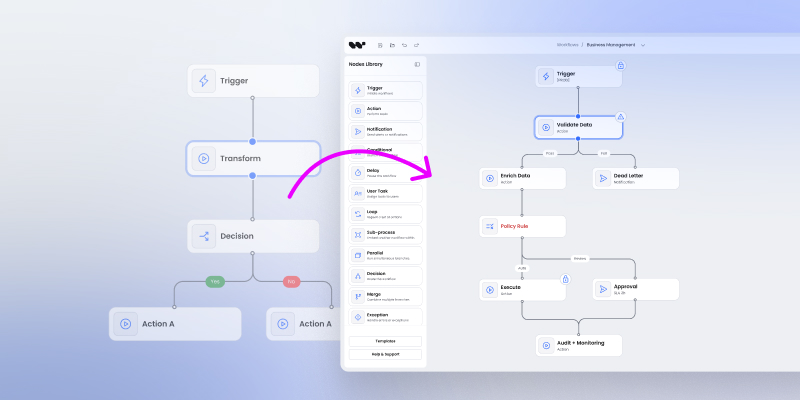
From React Flow templates to production: When a workflow editor becomes a real product feature
Learn why workflow editor templates are great for prototyping but often fall short at production scale. This article explains when and why teams move from templates to a production-ready workflow editor foundation — and what that transition really requires.

Building a new product with workflows at its core: why teams start with a workflow editor foundation
The article explains why teams building new products increasingly start with a workflow editor instead of building workflow UI from scratch. It shows how a frontend-only workflow foundation allows faster iteration, avoids early architectural lock-in, and keeps execution logic independent. You’ll learn when this approach makes sense for both standalone apps and embedded SaaS products.
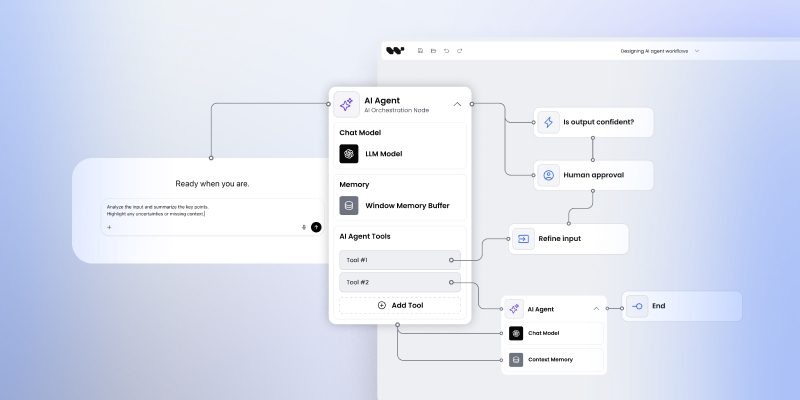
Designing AI agent workflows: why AI platforms need visual orchestration layers
The article explains why AI platforms need visual orchestration layers to make agent behavior understandable and controllable. It shows how frontend-only workflow builders expose logic, enable human-in-the-loop scenarios, and keep execution in existing AI backends. You’ll learn how visual workflows improve trust, debugging, and iteration in agent-based systems.